Arbitrage is life
I use “arbitrage” broadly here. Statistical trades, liquidation strategies and forecasts based on Mark Price can lose money even when implemented correctly. Mark Price is a reference value rather than an executable quote; knowing its formula does not guarantee an earlier or profitable trade. A price gap becomes an arbitrage opportunity only if the relevant legs can actually be executed and settled after fees, financing and transfer costs. Capital controls or sanctions can prevent that execution entirely. Small market size alone does not prove inefficiency, and access to ETF creation and redemption is generally restricted to authorized participants.
There's a common misconception that arbitrage is dead. That every profitable strategy has long since been captured by funds with thousands of servers, teams of quants, and billions under management.
In reality, that's simply not true.
The crypto market remains one of the most inefficient financial markets in the world. Thousands of exchanges, different trading rules, fee structures, APIs, pricing models, and data update speeds create countless local inefficiencies that are often too small for major players to care about.
A large fund won't assign an engineering team to a market doing just a few million dollars in daily volume. The economics don't make sense for them. But for a single developer or a small team, that same niche can be highly profitable.
That's why many arbitrage strategies are still very much alive today.
• Funding Rate Arbitrage - earning from funding rate differences between exchanges.
• Spot-Futures Arbitrage (Cash & Carry) - buying spot while simultaneously selling futures trading at a premium.
• Cross-Exchange Arbitrage - exploiting price differences between exchanges, including triangular arbitrage.
• Mark Price strategies - modeling the exchange's reference price from its published formula and available inputs; this involves timing and execution risk, not a guaranteed lead over other traders.
• Liquidation Arbitrage - trading against forced liquidations generated by exchange risk engines.
• Options Arbitrage - taking advantage of pricing inefficiencies in options and exotic derivatives.
• Statistical Arbitrage - identifying temporary deviations in historical statistical relationships between assets.
• Calendar Arbitrage - exploiting pricing distortions between contracts with different expiration dates.
• ETF / NAV Arbitrage - profiting from discrepancies between an ETF's market price and the value of its underlying assets.
What's even more interesting is that this isn't unique to crypto.
Arbitrage exists in every financial market.
Even traditional markets, often considered highly efficient, continuously generate opportunities.
During sanctions, massive pricing gaps emerge between countries, currencies, and exchanges. Capital controls, supply chain disruptions, and legal restrictions prevent prices from converging quickly. These periods often create some of the most profitable arbitrage opportunities available.
Military conflicts produce even greater distortions. Liquidity disappears, markets react unevenly, and assets become temporarily overvalued or undervalued relative to their fundamental value.
But even in peaceful times, markets make mistakes.
Market makers make mistakes.
Algorithms make mistakes.
Risk models make mistakes.
Large funds are sometimes forced to unwind positions because of internal risk limits, mandatory rebalancing, or liquidity constraints. Exchanges experience API failures, pricing delays, and temporary synchronization issues.
For most market participants, this is just noise.
For an engineer, it's an opportunity.
That's why I'm increasingly convinced that modern trading is becoming less of a financial discipline and more of an engineering one.
The winners won't be those who correctly predict where Bitcoin goes next.
The winners will be those who detect market inefficiencies faster than everyone else, automate their exploitation, and build systems that outperform the competition.
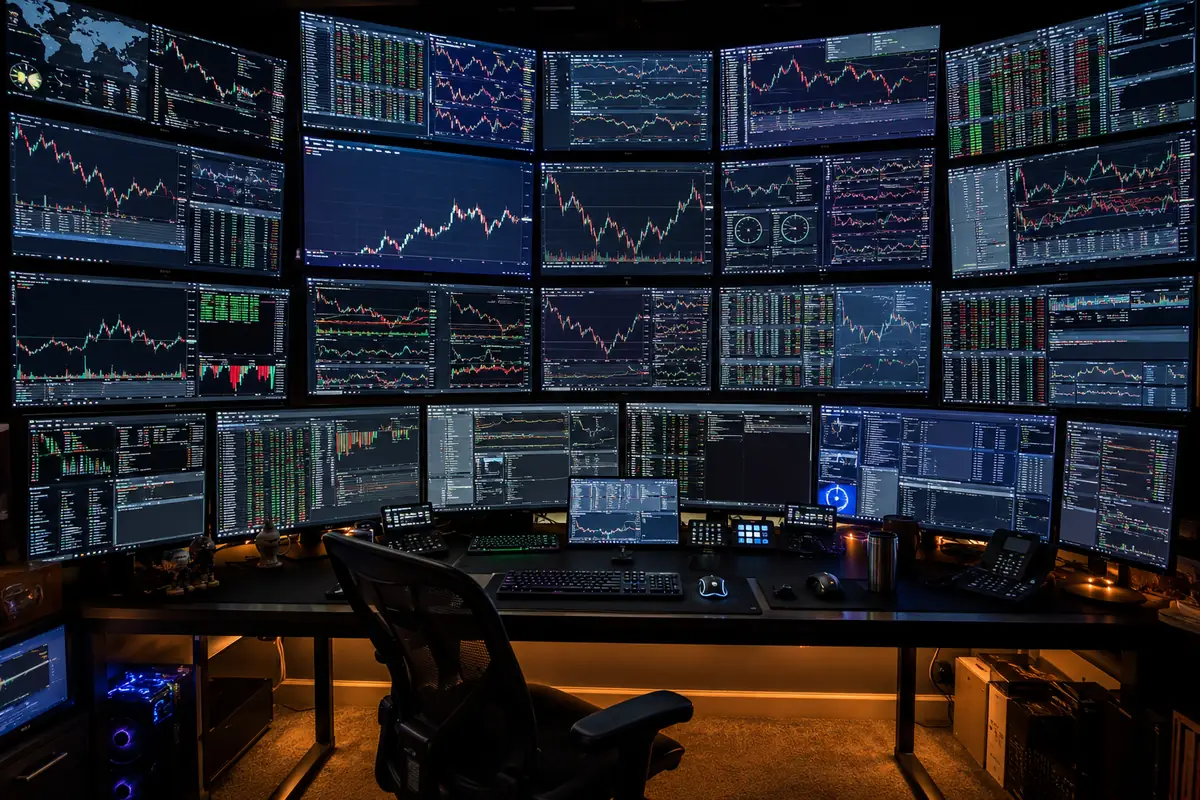
In a few years, successful traders will look far less like people staring at charts all day and far more like distributed systems engineers, low-latency software developers, and real-time data specialists.
And honestly, I find that future much more exciting.
Building systems, discovering patterns, and turning market chaos into algorithms is infinitely more interesting than trying to guess where the next candle will close.