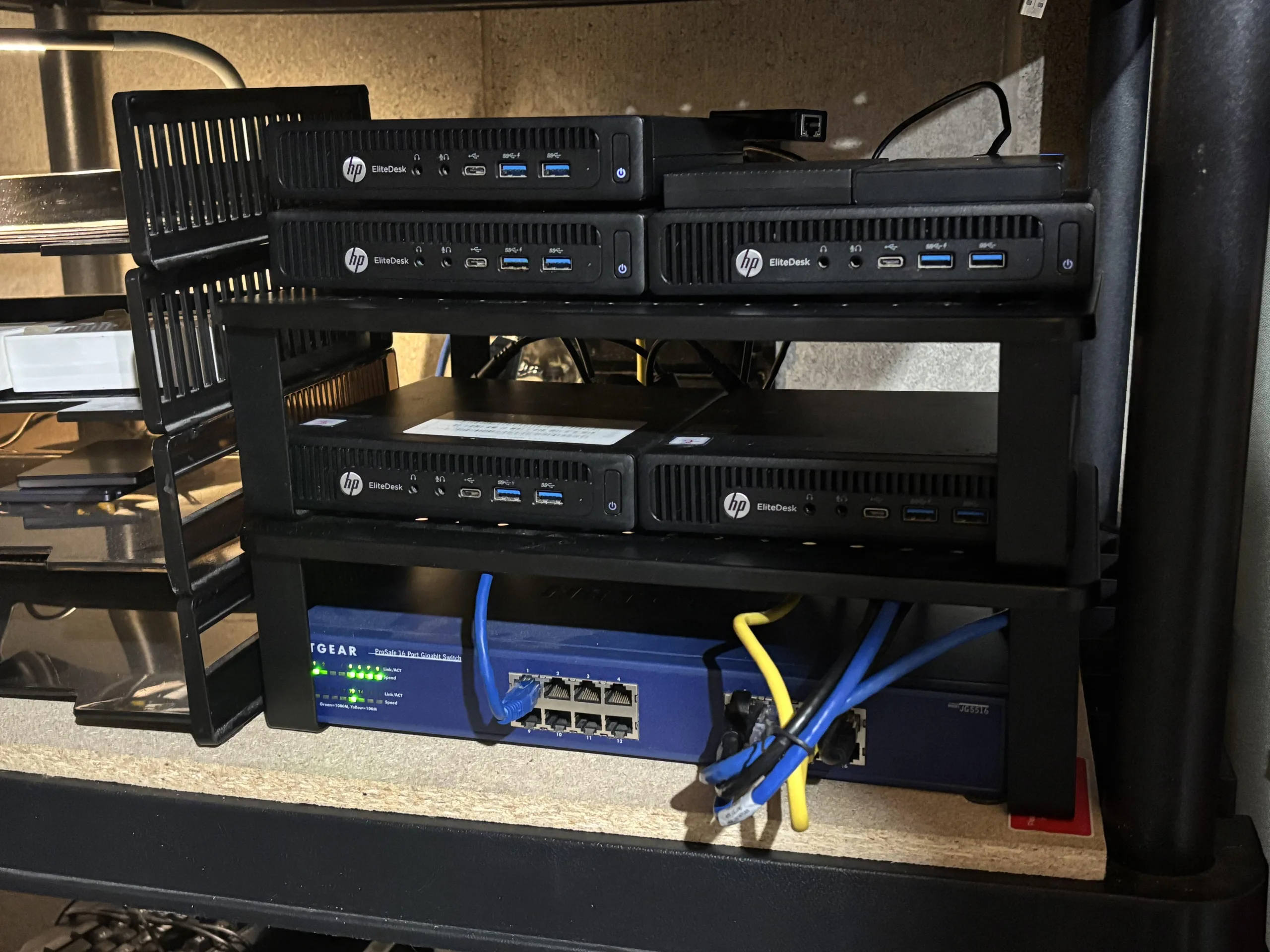
Home server system
My home system separates services into distinct roles with restricted network access. Some machines serve only the local network; others have controlled external connections or exchange events through specific endpoints. The list below describes 16 roles, not a one-to-one count of physically isolated boxes.
1. Web server
2. Security and video surveillance
3. Communications
4. Virtualization
5. Backup server
6. LLM
7. Statistics and monitoring
8. Firewall
9. Automation and smart home management
10. Server for apps working with external traffic
11. Game server
12. Private services
13. Infrastructure support systems
14. Torrent
15. Tape backup
16. Micro server for weather sensors
Web server
This server runs LAMP and Node applications as well as combinations of Rust, Python and C++. Pages that can be served as static files are exported to GitHub Pages or Cloudflare Pages; this site uses that approach too. Dynamic functions such as checkout, accounts or database writes still need a separate backend or external service. Removing public WordPress/PHP execution reduces the attack surface, but does not prevent compromised deployments, dependencies, accounts or client-side attacks. HTTPS protects traffic in transit; it does not fix application vulnerabilities.
Security and video surveillance
Consists of 3 parts: a powerful mini PC operating incoming video streams and the logic of capturing and recognizing moving objects; it has access to cameras and their servomotors and optics, as well as access to the second component-a file server where the current stream is stored and cleaned by the same server of everything that has no useful data from an AI perspective (essentially a stable picture without movement or brightness changes scaling with natural planetary cycles). And the last component is an archive server storing the last 3 months of uncleaned streams from all cameras, as well as archives of all movements in a catalog organized by groups. The entire system is completely closed and lacks access even to the local network; the only interaction is the ability to send events to the endpoint of another block.
Communications
This server is one of the few facing the outside world; it runs several classic open-source communication modules over various protocols for employees and relatives. The entire history is sent via endpoint to a server that accepts only text and several basic file types and stores it in a local MinIO.
Virtualization
Here stands a fairly powerful machine running several Windows and Hackintosh instances for various purposes, such as specific software.
Backup server
This machine has modest processing power but a large disk capacity. RAID can improve availability after a disk failure; it is not a backup and also mirrors accidental deletion or corruption. Recovery requires separate, versioned copies and tested restores. The tape archive described below is one additional layer.
LLM
A very powerful machine with enough GPU power to run an LLM of 64 billion parameters with an adequate token generation rate per second; it is fine-tuned slightly for specific needs and also has access to a huge dataset of strictly scientific and high-quality origin. The LLM is available only on the local network.
Statistics and monitoring
The machine is very simple and handles health monitoring and other parameters of all systems, which themselves ping its endpoints with required metrics.
Firewall
A professional hardware box that routes internet connections (multiple channels) or aggregates them for heavy tasks; it also has a small proxy farm with various mobile providers at its disposal. The operating logic of this setup allows achieving very high speeds by summing channels, as well as deeply analyzing traffic structure and attempts to tamper with it.
Automation and smart home management
The hardware handles things where if broken nothing terrible happens, but comfort and automation disappear-like turning on lights with a clap, or opening doors upon the approach of an NFC tag.
Server for apps working with external traffic
There are many applications that interact with the external network but do not accept incoming interactions from the outside-for example, trading bots or scrapers of news background info I am interested in.
Game server
My close ones and I are fans of certain network bestsellers so outdated that the online player count on my servers is comparable to or larger than official ones.
Private services
Despite the name, this server is fairly public and is used by family and team to replace standard services like Google Docs or Gmail.
Infrastructure support systems
A very important server managing pumps, solar panels, batteries, filters, heating, and many other critical systems; therefore it has high reliability and is duplicated by two identical servers with a heartbeat connection.
Torrent
I think no explanation is needed.
Tape backup
Information meeting the criteria "would like to keep forever" is constantly filtered from the entire stream and backed up to magnetic tape media on two separate tapes.
Micro server for weather sensors
A for-fun server that allows monitoring humidity and temperature at several locations, including outdoors, and compiling graphs and statistics to make decisions-for instance, driving greenhouse window actuators.